Who will win the 2027 NBA Western Conference Championship? Odds & predictions
San Antonio is the narrow Western Conference favorite at 46%, just ahead of Oklahoma City at 45% after their seven-game playoff battle. Minnesota at 19% and the Lakers at 17% have rebuilt around their star guards as they chase a place in the 2027 NBA Finals.
Basketball
By George Karmpoulonis
The San Antonio Spurs begin the 2026-27 season with the Western Conference crown and a narrow lead in the prediction market. At 46%, they sit just ahead of the Oklahoma City Thunder at 45%, setting up another close contest between Victor Wembanyama's team and the opponent it eliminated in last season's conference finals.
San Antonio has continuity on its side. Oklahoma City still has Shai Gilgeous-Alexander, Chet Holmgren and Jalen Williams, but several familiar rotation players have departed. Their next meeting in the playoffs, if it happens, would bring a different set of lineup decisions from the series the Spurs won in seven games.
The Minnesota Timberwolves and Los Angeles Lakers lead the next group at 19% and 17%. Minnesota has paired Anthony Edwards with LaMelo Ball, while the Lakers have reorganized around Luka Doncic following LeBron James' departure. Both have a credible offensive route into contention, along with questions about how their new combinations will defend.
Oklahoma City gets the narrow editorial prediction to win the West. San Antonio is the market favorite, but the Thunder's defensive foundation and potential for a healthier Williams offer a persuasive case for reversing last spring's result. Minnesota and Los Angeles need their offseason changes to translate into teams that can consistently challenge both leaders.
This article is for informational purposes only and should not be construed as financial or investment advice. Past performance does not guarantee future results.
2027 NBA Western Conference odds
The top four teams in the Western Conference championship market are:
- San Antonio Spurs: 46%
- Oklahoma City Thunder: 45%
- Minnesota Timberwolves: 19%
- Los Angeles Lakers: 17%
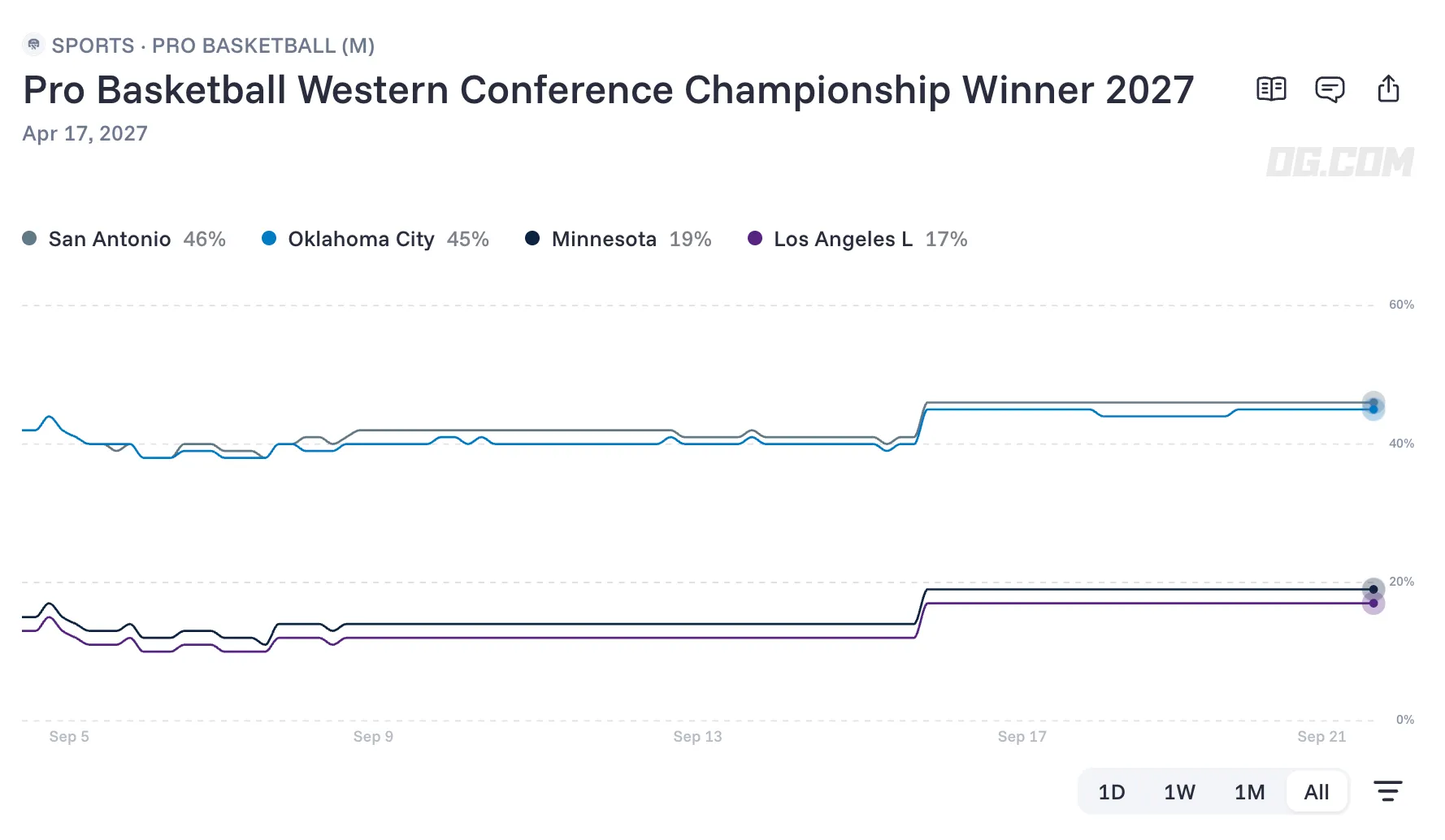
Market data as of September 21, 2026.
These percentages represent the market's assessment of winning the Western Conference playoffs and advancing to the NBA Finals. Finishing first in the regular-season standings is a separate achievement, although the resulting home-court advantage can help shape that playoff run.
The chart shows San Antonio and Oklahoma City moving closely together above Minnesota and Los Angeles. All four tracked prices rise around the middle of September, but the distinction between the leading pair and their challengers remains. There is only one percentage point between the Spurs and Thunder, compared with 26 points between Oklahoma City and Minnesota.
Western Conference odds for other listed teams
Team | Western Conference championship probability |
|---|---|
Denver Nuggets | 16% |
Houston Rockets | 14% |
Portland Trail Blazers | 13% |
Golden State Warriors | 13% |
Utah Jazz | 12% |
Sacramento Kings | 11% |
Phoenix Suns | 11% |
New Orleans Pelicans | 11% |
Memphis Grizzlies | 11% |
Los Angeles Clippers | 11% |
Denver is only one percentage point behind the Lakers, so fourth place in this market does not mark a decisive break from the rest of the conference. The Nuggets and Rockets remain relevant to any contender's route, particularly if seeding produces a demanding early-round series.
San Antonio Spurs Western Conference outlook — 46%
San Antonio's strongest argument is that its core has already solved the problem everyone else faces: getting through the West. The Spurs went 62-20 in the regular season and beat Oklahoma City in the conference finals before losing to New York in the championship series.
Wembanyama gives that team a distinctive advantage. He averaged 25.0 points, 11.5 rebounds and 3.1 blocks last season, combining primary scoring responsibility with protection at the basket. Against opponents built around attacking guards, his reach can turn an otherwise successful drive into a pass back out to the perimeter.
That changes how San Antonio can defend. Perimeter players have more room to pressure the ball when an elite shot blocker is behind them. It also creates a challenge for opposing coaches: drawing Wembanyama away from the rim only helps if the offense can exploit the space before he recovers.
The Spurs have preserved much of the group around him. De'Aaron Fox, Stephon Castle and Dylan Harper give coach Mitch Johnson several options for initiating offense, while Tobias Harris adds an experienced forward who can supply scoring without requiring the team to run everything through him.
Harris matters because conference opponents can force San Antonio into different kinds of games. Against Oklahoma City, his size offers another way to attack a smaller defender. Against a team that packs the paint, his shooting provides a potential outlet when a guard's route to the basket closes.
The larger offensive question is how Johnson combines his guards. Fox supplies experience and speed, Castle can attack through contact, and Harper's postseason emergence gives the Spurs another creator. Playing multiple drivers together is most effective when the remaining players stretch the defense and possessions keep moving after the first penetration.
San Antonio's vulnerability is an offense that becomes too crowded or too dependent on difficult individual shots. Wembanyama can rescue defensive possessions, but a conference title still requires reliable scoring against opponents that have several games to adjust.
At 46%, the Spurs have earned their place at the top. Their route to repeating is a familiar core becoming more efficient, with Harris widening Johnson's options. The question is whether that development outweighs the improvement Oklahoma City could get simply from having its principal creators available together.
Oklahoma City Thunder Western Conference outlook — 45%
Oklahoma City's 64-win regular season and seven-game conference finals appearance provide a strong starting point. The Thunder were close to returning to the Finals even with Williams limited to 33 regular-season games and affected by injuries during the playoffs.
Gilgeous-Alexander remains the player who makes their offense dependable. His second consecutive MVP season included averages of 31.1 points and 6.6 assists. He can create a useful shot after the defense has taken away the first option, an essential skill when a playoff possession slows down.
The Thunder also finished last season with the NBA's best defensive rating. Their path through the West does not require winning every matchup through offense alone. Pressure on the ball, help around the lane and disciplined rotations can keep a series competitive when their shooting fluctuates.
The offseason has made maintaining that standard more demanding. Lu Dort, Isaiah Joe and Aaron Wiggins were traded, removing established defensive assignments and shooting from coach Mark Daigneault's rotation. Cason Wallace and Ajay Mitchell are among the players positioned to take on more responsibility.
Those changes matter differently against each challenger. Oklahoma City needs guards who can stay with Edwards and Ball, defenders who can withstand Doncic's attempts to create a favorable matchup, and enough shooting to keep San Antonio from concentrating its defense around the basket.
Holmgren and Isaiah Hartenstein give Daigneault alternatives in the frontcourt. Holmgren can space the floor while protecting the rim, and Hartenstein adds screening and rebounding. That flexibility helps, but neither arrangement removes the need for a second perimeter creator to make the defense react.
Williams is therefore central to the prediction. If he can consistently attack a defense already occupied by Gilgeous-Alexander, Oklahoma City can generate more opportunities before a shot blocker gets into position. His availability would also give Daigneault more freedom to distribute the offensive workload throughout a series.
The 45% price captures a team that remains almost inseparable from the defending conference champion. Oklahoma City's case for moving ahead depends on its younger guards replacing lost production and Williams providing the sustained contribution that was missing for much of last season. If either condition fails, San Antonio's greater continuity becomes a stronger advantage.
Minnesota Timberwolves Western Conference outlook — 19%
Minnesota's offseason addresses a recurring challenge for teams built around a dominant scorer: how to make his job easier without reducing his influence. Ball gives Edwards another high-level passer who can organize possessions and create opportunities before the defense settles.
The Timberwolves won 49 games last season and reached the second round, following consecutive conference finals appearances in 2024 and 2025. Their new backcourt raises the possibility of a more fluid attack, but the roster that made those earlier runs has changed substantially.
Ball can advance the ball quickly, find a cutter and deliver a pass to Rudy Gobert above the defense. Those skills should allow Edwards to receive the ball with an advantage more often, rather than having to manufacture one against a set defense on every possession.
The cost of that change is important. Naz Reid and Julius Randle are gone, taking away frontcourt scoring and lineup options. Minnesota subsequently added Jonathan Kuminga, giving coach Chris Finch another athletic forward alongside Jaden McDaniels, but the new group must establish how it spaces the floor around Gobert.
Kuminga's cutting and ability to attack the basket could work well with Ball's passing. The risk is that lineups containing several players who do their best work inside give opposing big men fewer reasons to leave the lane. Against Wembanyama or Holmgren, that can make Edwards' finishes more difficult rather than easier.
Donte DiVincenzo's recovery from a ruptured right Achilles adds another complication. There is no confirmed return timetable, so Minnesota cannot build its early-season shooting plan around his availability. Ayo Dosunmu provides another established guard, but DiVincenzo's eventual contribution remains uncertain.
Ball's availability also matters. His 72 appearances last season were an encouraging change after several injury-disrupted campaigns. Minnesota needs that durability to continue if the new backcourt is to develop the timing required for a long playoff run.
The Timberwolves' route to a conference title is an offense that becomes more varied without surrendering too much defense or rebounding. Ball and Edwards have considerable upside together. At 19%, however, Minnesota still has to demonstrate that the new balance works against the two teams above it, particularly when opponents force its supporting players to make shots and decisions.
Los Angeles Lakers Western Conference outlook — 17%
The Lakers have made their direction clear: build an offense around Doncic and give him a supporting cast suited to his strengths. James' move to Philadelphia ends their shared arrangement, while Walker Kessler arrives to provide a different presence at center.
Doncic averaged 33.5 points and 8.3 assists last season. His scoring attracts extra defenders, and his passing can turn that attention into open shots or finishes at the rim. The question is how consistently the players around him convert those opportunities while doing enough at the other end.
Kessler is important to both tasks. As a screen setter and lob target, he can force a defender to choose between containing Doncic and protecting the basket. Defensively, his size offers protection behind the guards and a chance to end possessions with rebounds.
Austin Reaves remains the other major creator. His ability to run a possession gives coach JJ Redick an alternative when opponents pressure Doncic or force him to release the ball. Collin Sexton adds another guard who can attack, while Quentin Grimes provides a potential combination of perimeter defense and shooting.
That combination is particularly valuable in the West. Against Oklahoma City or Minnesota, the Lakers need someone to take a demanding guard assignment without allowing his own defender to ignore him at the other end. Grimes' effectiveness in that role could influence which lineups Redick trusts late in games.
Health is another material factor. Doncic's hamstring injury kept him out of last season's playoffs, and Kessler played only five games for Utah before shoulder surgery ended his season. Their new partnership has to withstand a full campaign as well as function on paper.
There is a defensive question beyond the center position. Kessler cannot protect the rim and every open shooter simultaneously. If the Lakers allow repeated penetration, opponents can force him to help and then move the ball to the space he has left. The perimeter defenders need to contain enough drives to make his presence count.
The Lakers can challenge the conference leaders if Doncic and Reaves generate efficient offense while the rebuilt defense becomes reliable. At 17%, the market places them in the leading group of challengers, but a conference title would require a substantial improvement in how the entire lineup survives repeated playoff attacks.
Three factors that could decide the Western Conference
1) Can the challengers make the leading defenses move?
San Antonio and Oklahoma City give opponents different problems, but both can make a simple drive-and-finish offense uncomfortable. Beating them requires creating a second opening after the initial defender is beaten or the first pass is made.
That is why Minnesota's acquisition of Ball and the Lakers' addition of Kessler matter. Ball can find the next option before help arrives; Kessler can occupy a defender near the basket while Doncic manipulates the screen. Those advantages only last if the remaining players provide enough shooting and movement to prevent the defense from recovering.
2) Which rotations can survive targeted playoff matchups?
Regular-season depth and playoff depth are different tests. A player who supplies useful minutes over several months can become difficult to keep on the floor if an opponent repeatedly attacks his defense or ignores his shot.
Oklahoma City's younger guards must hold up in larger roles. San Antonio needs effective combinations around Wembanyama without crowding the offense. Minnesota has to replace the flexibility lost with Reid and Randle, while the Lakers must find a balance between perimeter defense and offensive support.
3) How much will seeding change the path?
The conference championship requires winning three playoff series. A difficult first-round opponent can expose a weak rotation, increase the workload on a star or force a team to reveal adjustments earlier than intended.
For Minnesota and the Lakers, improving their regular-season position could help them avoid an immediate meeting with one of the leading pair. For San Antonio and Oklahoma City, securing home-court advantage would matter if another series reaches a seventh game.
Denver sits close behind the top four in the market, and Houston is also within the pursuing group. Their presence makes it risky to assume a clean route into an anticipated Spurs-Thunder rematch. The bracket will determine which weaknesses each contender has to solve first.
2027 NBA Western Conference prediction
Oklahoma City is the narrow prediction to win the Western Conference, despite San Antonio holding the slight market lead.
The Thunder combine an established defensive system with a lead scorer who can create against almost any coverage. More consistent availability from Williams would give that attack a second source of penetration, making it harder for an opponent to concentrate on Gilgeous-Alexander over an entire series.
That is a conditional advantage. Oklahoma City has to replace the minutes and assignments left by its departed perimeter players. If the younger guards cannot maintain the defensive standard, or Williams is again unavailable for important stretches, the argument shifts toward San Antonio.
The Spurs are the clearest alternative because they have already beaten this opponent and have retained much of the group that did it. Wembanyama's ability to influence both ends gives them a way to control a series even without exceptional outside shooting. More dependable guard combinations could be enough to keep them ahead.
Minnesota has the strongest opportunity among the next two to change its offensive identity through a new partnership. The Lakers have an elite individual creator capable of putting pressure on any defense. Both need their new lineups to prove they can defend and rebound well enough to sustain that threat through three rounds.
The early call is Oklahoma City by a small margin, with San Antonio close enough that availability and rotation development could reverse the order. The one-point market gap is consistent with a contest that should remain unsettled well into the season.
What could move Western Conference odds during the season?
The first meaningful evidence will come from how the new and expanded roles work against strong opponents. Oklahoma City's perimeter defense, San Antonio's guard combinations, Minnesota's spacing around Edwards and Ball, and the Lakers' ability to contain drives will reveal more than an isolated high-scoring performance.
Availability can also change the hierarchy. Sustained stretches with Williams in the lineup would strengthen the Thunder's case. Minnesota's outlook could change if DiVincenzo returns and contributes effectively, while the Lakers need Doncic and Kessler to establish both chemistry and durability.
Trades would matter most if they address a specific postseason weakness. Another dependable forward, a shooter who can defend or a reserve center capable of handling an unfavorable matchup could change a team's options without altering its headline stars.
By spring, seeding and likely opponents should carry more weight. A contender whose best lineup matches up well with its projected bracket may have a clearer path than a team with a similar record facing repeated problems at the same position.
Important Information
Prediction is an event contract that is a derivatives product offered by North American Derivatives Exchange, Inc. (NADEX), a CFTC-regulated exchange, which does business under the brand OG.com Prediction Markets (OG). Crypto.com | Derivatives North America uses a CFTC-regulated exchange that uses OG.com technology.
Trading on OG.com involves risk and may not be appropriate for all. By trading you risk losing your cost to enter any transaction, including fees. You should carefully consider whether trading on OG.com is appropriate for you in light of your investment experience and financial resources. Any trading decisions you make are solely your responsibility and at your own risk.