Which teams will be relegated from the Premier League?
Premier League relegation is one of the most significant things that can happen to a club. Dropping into the Championship can reshape its finances, squad and plans for years to come.
Soccer
By Sean O'Meara

The battle often stays open until the final weeks, with one good run – or a few poor results – changing the picture quickly.
In this article, we look at the leading Premier League relegation candidates, what could move the markets and which teams might surprise us this season.
Which teams will be relegated from the Premier League?
The Premier League relegation battle ends with three clubs dropping into the Championship. For 2026/27, newly promoted Coventry City, Ipswich Town and Hull City are already among the teams under the spotlight.
Recent history explains why. Of the 30 clubs relegated over the past 10 seasons, 16 had only been promoted the season before. In both 2023/24 and 2024/25, all three promoted teams went straight back down. That does not guarantee another promoted club will be relegated, but it shows how difficult the step up can be.
Hull may face the biggest challenge. They finished sixth in the Championship and secured promotion through the play-offs, ending the regular season 22 points behind champions Coventry. Coventry arrive with stronger Championship form, while manager Frank Lampard also has Premier League experience.
Ipswich manager Gary O’Neil has managed in the top flight with Bournemouth and Wolves. He helped Bournemouth avoid relegation but was later dismissed by Wolves following a difficult start to the season.
Promoted teams can still outperform expectations. They often arrive with momentum, a settled system and confidence from the previous season. However, the Premier League brings stronger opposition, deeper squads and far less room for poor runs of form.
The relegation picture will not be limited to the promoted clubs. Established teams could also be pulled into the battle if they lose important players, struggle with injuries or fail to strengthen during the summer transfer window.
Premier League relegations in last 10 seasons
- 2025-26: Burnley (straight back down), West Ham United, Wolverhampton Wanderers
- 2024-25: Leicester City (straight back down), Ipswich Town (straight back down), Southampton (straight back down)
- 2023-24: Luton Town (straight back down), Burnley (straight back down), Sheffield United (straight back down)
- 2022-23: Leicester City, Leeds United, Southampton
- 2021-22: Norwich City (straight back down), Watford (straight back down), Burnley
- 2020-21: Fulham (straight back down), West Bromwich Albion (straight back down), Sheffield United
- 2019-20: Norwich City (straight back down), Bournemouth, Watford
- 2018-19: Cardiff City (straight back down), Fulham (straight back down), Huddersfield Town
- 2017-18: Swansea City, Stoke City, West Bromwich Albion
- 2016-17: Hull City (straight back down), Middlesbrough (straight back down), Sunderland
Second season syndrome
Second season syndrome refers to the trend of teams surviving in the Premier League for a year, before having a terrible second season due to loss of winning momentum. Although it’s a well used phrase, the phenomenon has only played out twice in the past ten years.
Sheffield United were promoted in 2019, survived one season and relegated at the end of 2020-21 and Huddersfield Town were promoted in 2017, survived one season and were relegated at the end of 2018-19.
Premier League yo-yo clubs
‘Yo-yo clubs’ are those that tend to overperform in The Championship and underperform in The Premier League, leading to a run of relegations and promotions back and forth.
Fulham are a good example. They were relegated in 2019, promoted in 2020, relegated again in 2021, then promoted in 2022, a perfect bounce every single year before finally settling as an established top-flight side.
Norwich City matches them for pure yo-yo rhythm, going up in 2019, down in 2020, up in 2021, and down again in 2022, twice winning the Championship only to finish bottom of The Premier League.
Burnley were promoted in 2023, relegated in 2024, promoted again in 2025, and relegated again in 2026, up and down in four straight seasons. Watford were relegated in 2020, promoted in 2021, and relegated in 2022.
Other candidates for relegation
Aside from the three promoted teams and two teams potentially experiencing ‘second season syndrome’ (Leeds United and Sunderland), there are a handful of established Premier League teams who may be at higher than usual risk of relegation.
Factors that influence this include loss of key players, change of manager, gradual decline and a habit for ‘circling the drain’ most seasons, but somehow surviving. Wolverhampton Wanderers are a good example of the latter.
Out of the teams outside of the ‘Big Six’, Crystal Palace, Bournemouth, Ipswich Town, Fulham, Newcastle United, Nottingham Forest and Tottenham Hotspur have new managers. Arguably, Nottingham Forest and Tottenham Hotspur have ‘upgraded’ their managers, while Crystal Palace, Bournemouth, Fulham and Newcastle United have parted ways with managers that arguably have performed well for them.
Of those teams, Bournemouth, Newcastle United, Fulham and Crystal Palace have lost key players too.
How does Premier League relegation work?
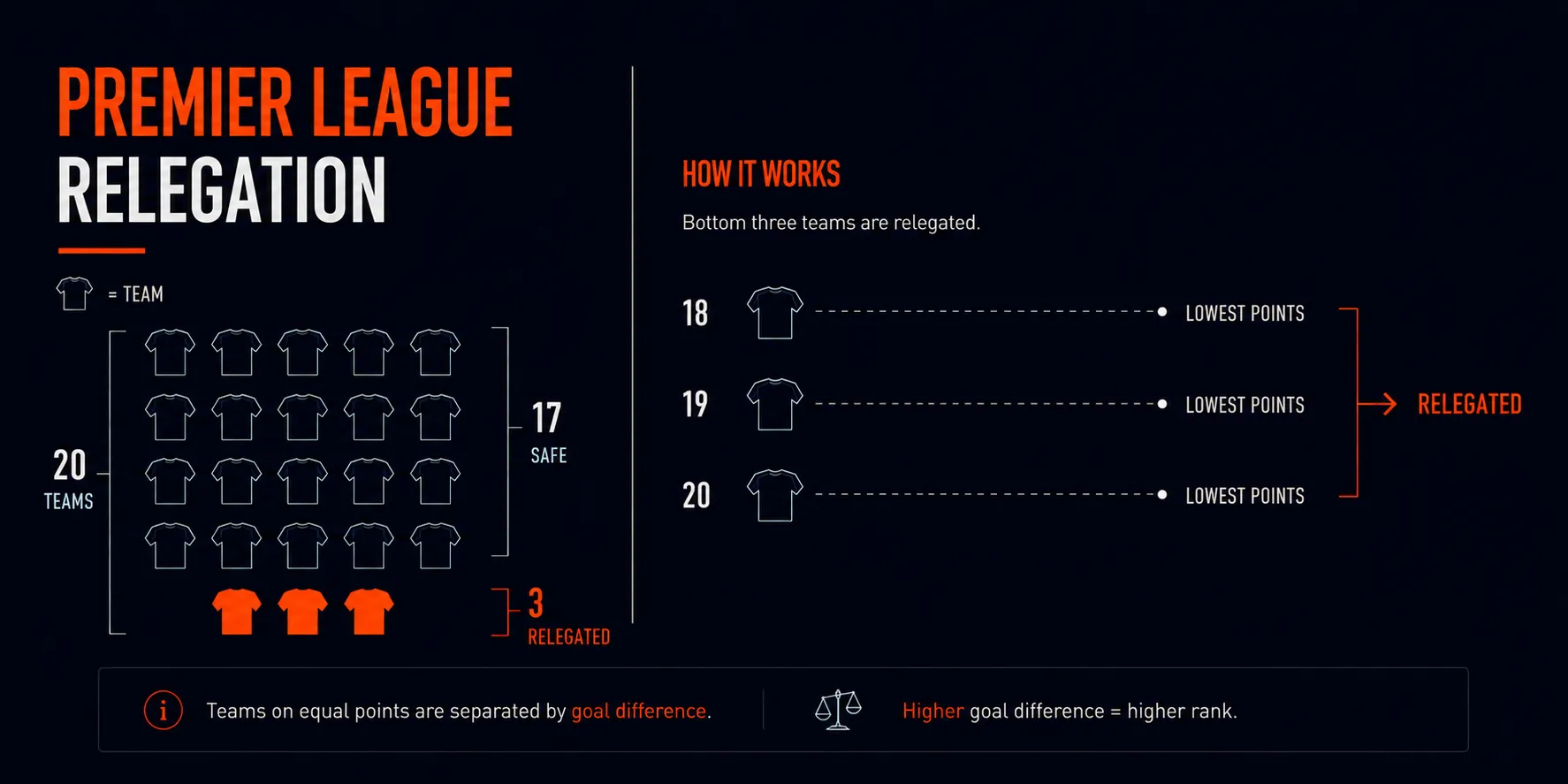
Premier League relegation is based on rankings in a 20-team league. The bottom three teams will always be relegated. Normally three teams finishing on the lowest points will be relegated. Teams finishing on equal points will be separated by goal difference.
There are certain theoretical scenarios where the three teams with the least points at the end of the season may not all be relegated. For example, if a team finishing on a greater number of points is retroactively given a points deduction, which then places them below one or all of the three lowest placed teams, then only two of the teams that finished the season in the relegation zone will be relegated.
How many points to avoid relegation?
Pundits often refer to the ‘magic 40-point mark’ and managers of teams at potential risk of relegation set 40 points as a milestone. And while 40 points normally ensures survival, it’s not always the case.
West Ham United were relegated in the 2002-2003 season with 42 points, the highest ever Premier League points total for a relegated team. According to the BBC, in the 30 seasons to and including the 2024-2025 season, 60% of teams finishing on or above 36 points survived. The survival probability increases to 80% for 38 points, 90% for 40%. No team has been relegated with 43 or more points.
Which clubs have never been relegated?
Six of the clubs that founded the Premier League have never been relegated; Arsenal, Manchester United, Tottenham, Liverpool and Chelsea, and Everton. Brighton were first promoted to the Premier League in 2017 and have never been relegated.
Looking back beyond the formation of the Premier League, only Arsenal and Everton have never been relegated from the top tier of English soccer.
What happens to a club when relegated?
They play the next season in the league below. When relegated from the Premier League, teams play in The Championship. Some teams come straight back up, some get stuck in The Championship and some teams suffer a ‘double-dip’ relegation, like Leicester City did in the 2025-2026 season.
A few other things change too. Teams relegated from the Premier League receive less revenue from TV rights sales and sponsorship, although they receive ‘parachute payments’ to soften the blow as they may have signed players on Premier League wages for contracts longer than their tenure in the Premier League.
Teams may also have contractual obligations to allow players to leave in the event of relegation and many teams include relegation clauses in player contracts that trigger a wage reduction. The loss of Premier League status also affects cup competitions, meaning relegated teams play preliminary rounds in the League Cup.
FAQs about Premier League relegations
Which teams were relegated in 2025/26?
Wolverhampton Wanderers (Wolves), Burnley and West Ham were relegated. Both Wolves and West Ham were established Premier League teams with multiple seasons in the top flight. Burnley were relegated after being promoted the season before, after being relegated the season before that.
Which teams were promoted for 2026/27?
The teams promoted to the Premier League for the 2026-2027 season were Championship champions Coventry City, runners-up Ipswich Town who returned one season after relegation, and Hull City, who were unexpectedly promoted after qualifying for the playoffs.
How much does Premier League relegation cost?
Depending on commercial deals, player wages and contracts, Premier League relegation can cost anywhere between £75 million ($102 million) and £100 million ($136 million).
How can teams be relegated before the end of the season?
Teams are often relegated before the season ends. If the number of points available, assuming they win all games, is less than the difference between their current points total and the points total of the team in 17th place, they are relegated, although they don’t change leagues until the following season.
What does ‘all but relegated’ mean?
A team is “all but relegated” when survival remains mathematically possible but is extremely unlikely. It may need to win every remaining game while its rivals lose, or overturn a large goal-difference deficit.
Which player has the most Premier League relegations?
Welsh Striker Nathan Blake has been relegated five times. Across a ten year period, he was relegated with four different teams; Sheffield United in 1995, Bolton in 1996 and 1998, Blackburn in 1999 Wolverhampton Wanderers in 2004. Blake has been relegated in consecutive seasons twice, having moved from Sheffield United to Bolton Wanderers in 1995 and from Bolton to Blackburn in 1998.