Who will win the US Open women's singles? Prediction and odds
Aryna Sabalenka is favorite to win a third consecutive US Open title, but Coco Gauff and Iga Swiatek arrive in form and the 2026 women's majors have been anything but predictable.
Tennis
By Chris Old
Three Grand Slams. Three different women's champions.
Elena Rybakina began 2026 by winning the Australian Open. Mirra Andreeva broke through at Roland Garros. Linda Noskova followed with her first major at Wimbledon.
The final major of the year now brings the field to New York, where Aryna Sabalenka is trying to do something none of them have managed this season: win a second Slam.
Sabalenka has won the last two US Opens and remains world No. 1, making her the natural favorite. But her recent form has been less convincing than her record here.
Coco Gauff has just won Cincinnati. Iga Swiatek won Toronto. Jessica Pegula reached the Cincinnati final, while Rybakina may have one of the strongest hard-court games in the field if her injured ankle holds up.
Naomi Osaka brings two US Open titles of her own, Andreeva has already shown she can win a major, and the wider field includes enough former champions, finalists and in-form challengers to make this one of the deeper women's draws in recent years.
Sabalenka deserves to start favorite, but this does not look like a tournament she owns before a ball has been struck.
This article is for informational purposes only and should not be construed as financial or investment advice. Past performance does not guarantee future results.
Who will win the US Open women's singles?
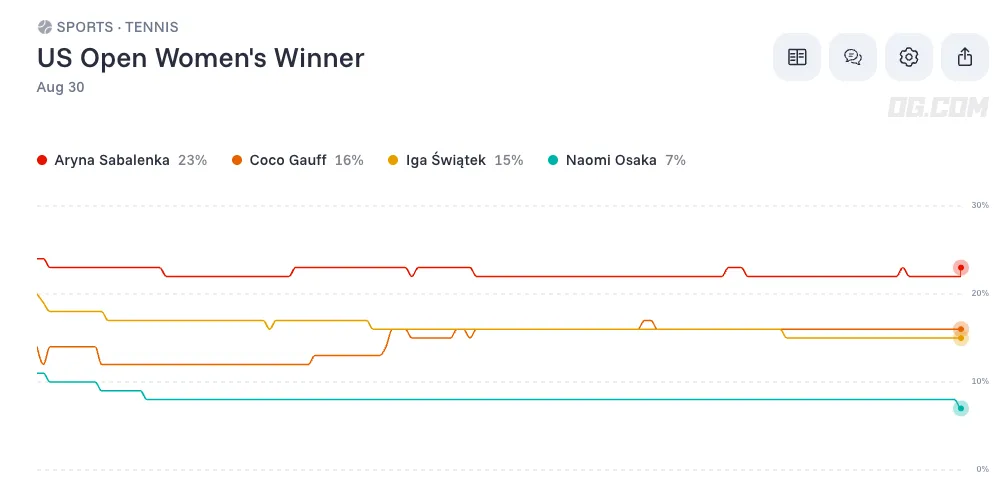
Prediction markets for US Open Women's Winner currently make Aryna Sabalenka the favorite at 23%, ahead of Gauff and Swiatek.
Aryna Sabalenka — 23%
Coco Gauff — 16%
Iga Swiatek — 15%
Naomi Osaka — 7%
Mirra Andreeva — 7%
Elena Rybakina — 7%
Jessica Pegula — 7%
Market data as of August 27, 2026. Prices can move throughout the tournament. For the latest market-implied probabilities, check the OG app.
The first thing that stands out is the absence of an overwhelming favorite.
Sabalenka has won this tournament twice in succession, but prediction markets still give her less than a one-in-four market-implied probability of making it three.
That reflects the strength of the field as much as concern about Sabalenka.
Gauff arrives directly from a Cincinnati title. Swiatek has rediscovered her hard-court form after winning Toronto. Rybakina is already a major champion this season. Andreeva is too. Pegula has gone 10–3 across her three North American hard-court tournaments.
The draw adds another wrinkle. Sabalenka, Pegula and Wimbledon champion Noskova are concentrated in the top half. Gauff, Swiatek, Rybakina, Andreeva, Osaka and Anisimova are all below them.
That makes the bottom half particularly deep.
But the tournament should not be reduced to bracket positioning.
Sabalenka has the best recent US Open record. Gauff and Swiatek have the freshest form. Rybakina may possess the most dangerous hard-court game if healthy. Andreeva has already shown this year that age is no barrier to winning a major.
There are credible cases everywhere.
1. Aryna Sabalenka
Current title probability: 23%
There is one enormous reason Sabalenka remains favorite: she keeps winning here.
Sabalenka lifted the US Open trophy in both 2024 and 2025 and is trying to become the first woman since Serena Williams to win three consecutive titles in New York. Last year she lost only one set across the tournament.
Few players are better equipped for these conditions when everything is working.
The first serve gives Sabalenka cheap points. Her return position allows her to attack immediately. And very few opponents can withstand her weight of shot for an entire match once she starts consistently finding the court.
Her 2026 season began accordingly. Sabalenka went 23–1 through the Sunshine Swing, including titles at Indian Wells and Miami.
The problem is that the second half of the season has looked very different.
She lost to Ekaterina Alexandrova in the fourth round in Toronto, then fell in straight sets to Sara Bejlek at the same stage in Cincinnati. She therefore arrives without a deep run in either of the two main hard-court tune-ups.
That makes this a slightly unusual Sabalenka title defense.
Her New York record breeds trust; her immediate form says ask questions.
The draw is mixed rather than obviously easy. Sabalenka starts against Camila Osorio, but Barbora Krejcikova could appear in the third round and Diana Shnaider in the fourth. Wimbledon champion Noskova is her projected quarterfinal opponent.
Still, most of the other leading market contenders have landed in the opposite half.
Sabalenka cannot meet Gauff, Swiatek, Rybakina, Osaka or Andreeva until the final.
At 23%, the market is balancing two competing truths.
Nobody in this field has been better at the US Open recently. Sabalenka simply has not looked like the best player in women's tennis recently.
2. Coco Gauff
Current title probability: 16%
Gauff could hardly have timed her best hard-court week of the season better.
She won Cincinnati on Sunday, beating Jessica Pegula in straight sets in the final. After losing the opening set of her first match, Gauff went on to win 12 consecutive sets on her way to the trophy.
That immediately changes the complexion of her US Open challenge.
Gauff already knows what winning here requires. She became US Open champion in 2023 and has since developed into one of the best defensive players on tour while becoming more willing to take control of points herself.
There are still vulnerabilities. The serve has been inconsistent at times this season. So has the forehand. When opponents can attack the second serve and keep Gauff from settling into extended rallies, matches can become uncomfortable quickly.
Cincinnati was encouraging because those weaknesses never took over the tournament.
There is also something to be said for arriving in New York after winning.
Confidence does not guarantee anything in a best-of-three knockout tournament, but Gauff enters knowing her movement, return game and competitive instincts are all working.
Her draw is one of the more demanding among the favorites.
Gauff opens against Zeynep Sonmez and could face the winner of Daria Kasatkina against Paula Badosa in Round 2. Further ahead, Alexandra Eala and Iva Jovic occupy the same section, with Anisimova and Andreeva also in Gauff's quarter.
The projected quarterfinal is Gauff against Andreeva. That is not a free route into the final weekend.
But 16% is not based primarily on the draw.
It reflects a former champion who has just won the final major warm-up and arrives with considerably more momentum than the woman above her in the market.
3. Iga Swiatek
Current title probability: 15%
Swiatek looked a long way from this position earlier in the year.
Now she may be the most interesting member of the top three.
Her Toronto title changed the picture.
Swiatek beat Rybakina 6–2, 6–3 in 75 minutes in the final, claiming her first trophy of 2026 and her 12th WTA 1000 title. She then reached the Cincinnati semifinals before losing a close three-set match to Pegula.
That is important because hard courts had become part of the question around Swiatek rather than an automatic strength.
At her best, she remains one of the most oppressive returners in the sport.
Swiatek takes time away on second serves, moves exceptionally well laterally and can produce stretches in which an opponent barely gets through a service game without facing pressure.
She also has history here. Swiatek won the US Open in 2022.
The draw gives her reasons for optimism, although it is hardly empty.
She starts against Xiyu Wang and could meet Madison Keys in the fourth round. More significantly, Rybakina is the projected quarterfinal opponent.
That matchup has become one of the most compelling in women's tennis.
Rybakina beat Swiatek in the Australian Open quarterfinals this year. Swiatek answered emphatically in the Toronto final, and their Cincinnati meeting ended when Rybakina retired injured.
At 15%, Swiatek sits only one point behind Gauff. That feels appropriate.
Gauff has the most recent trophy; Swiatek has produced the stronger run across both Toronto and Cincinnati.
4. Naomi Osaka
Current title probability: 7%
The market groups four players together at 7%.
Osaka may carry the greatest hard-court pedigree of them all.
She has won four major singles titles, including the US Open in 2018 and 2020, and all four came on hard courts.
For a long time, that résumé was doing considerably more work than her current form.
That is less true now. Osaka put together another solid North American swing and reached the Toronto quarterfinals, where she pushed eventual finalist Rybakina to 4–6, 7–6, 6–4.
The underlying appeal has never been complicated.
When Osaka is serving well and taking the ball early, there are very few players who can stop her dictating on a hard court. She can finish points before even elite defenders have time to turn them into the kind of physical exchange they want.
New York also holds none of the mystery it does for younger contenders: she has won here twice.
The difficulty is her draw. Osaka sits in Rybakina's section, creating a possible fourth-round rematch of their Toronto battle. Swiatek could then await the winner in the quarterfinals.
That is a formidable route.
But tournament winner markets are about whether someone can ultimately beat elite players.
For Osaka, that is not really the question.
The question is whether she can produce her best level often enough to do it several times in the same fortnight.
5. Mirra Andreeva
Current title probability: 7%
Andreeva enters her fourth US Open as something she had never been before this season.
A Grand Slam champion.
She won Roland Garros in June at 19, dropping only one set throughout the tournament before beating Maja Chwalinska 6–3, 6–2 in the final.
That matters beyond the trophy itself. For years the conversation around Andreeva was about potential.
Could she handle the latter stages of a major? Could she maintain her level when expectations changed? Could she finish the job once she became the player everybody expected to win?
Paris answered those questions. Hard courts ask a slightly different one.
Andreeva does not possess the outright serving power of Sabalenka, Rybakina or Osaka. Her strength comes from reading points early, changing direction, defending intelligently and increasingly knowing when to stop defending and attack.
The North American preparation has been less convincing than her clay season.
In Cincinnati, Marta Kostyuk beat her 4–6, 6–0, 6–2 in the fourth round. It was Kostyuk's third win in four meetings between the pair.
Andreeva has also landed in a difficult quarter.
The No. 5 seed shares it with Gauff and Anisimova, while Ostapenko, Eala and Jovic add further danger before the projected Gauff-Andreeva quarterfinal.
Still, 7% no longer looks like a speculative price on a prodigy. Andreeva has already won one of these and everyone else now has to treat her accordingly.
6. Elena Rybakina
Current title probability: 7%
If Rybakina were unquestionably healthy, 7% would be one of the more surprising numbers in the market.
She won the Australian Open in January, beating Swiatek in the quarterfinals before defeating Sabalenka in three sets in the final. She also leads the 2026 WTA Finals race after another deep run in Toronto.
The hard-court credentials are beyond dispute.
Rybakina has one of the best serves in women's tennis and backs it with flat, penetrating groundstrokes that can take time away before opponents establish themselves in the rally.
Her Toronto run reinforced that. She came from behind to beat Osaka in the quarterfinals, then Gauff in the semifinals, before Swiatek stopped her in the final.
Then came Cincinnati. Rybakina retired from her quarterfinal against Swiatek with a left ankle injury, struggling to push off on serve before ending the match.
That is the obvious reason for caution.
The draw would have been demanding even at full fitness. Rybakina could meet Osaka in Round 4 before another potential meeting with Swiatek in the quarterfinals.
A healthy Rybakina can beat both. She has already beaten Swiatek at a major this year.
But fitness changes how we interpret everything. The first few rounds will therefore matter more for Rybakina than for almost any other major contender.
If she moves freely, 7% may not last long.
Who else could win the US Open?
The field remains deep beyond the six leading cases.
Jessica Pegula — 7%
Pegula deserves far more than a passing mention.
She has gone 10–3 across Washington, Toronto and Cincinnati, reaching the finals in Washington and Cincinnati. In Ohio she beat Anisimova and Swiatek before Gauff stopped her in the final.
Her US Open record is relevant too. Pegula reached the final in 2024 and returned to the semifinals last year.
The draw has placed her in Sabalenka's half rather than the crowded bottom section.
She begins against Elena-Gabriela Ruse and is projected toward a quarterfinal with Karolina Muchova, although Svitolina, Paolini and Cirstea all occupy that broader section.
At 7%, Pegula has the combination of current form, hard-court consistency and New York history to make another final entirely plausible.
Amanda Anisimova — 5%
Last year's finalist remains dangerous.
Anisimova reached the 2025 US Open final after also making the Wimbledon final earlier that summer, proof that her clean ball-striking can survive deep into a major.
Her preparation this time has been encouraging rather than spectacular.
She reached the Cincinnati quarterfinals before losing a third-set tiebreak to Pegula.
The problem is the company she keeps. Anisimova sits in the same quarter as Gauff and Andreeva.
There will be very little room for an indifferent match.
Marta Kostyuk — 5%
Kostyuk has quietly put together one of the strongest seasons of her career.
She has won titles in Madrid and Rouen and reached eight Top 10 victories by the Cincinnati quarterfinals, tied for the tour lead at that point.
Her Cincinnati win over Andreeva was particularly impressive: she lost the opening set and then conceded only two games across the next two.
The draw puts her in Sabalenka's quarter. A deep run would therefore probably require navigating the defending champion's section rather than hoping somebody else removes her.
Alexandra Eala — 4%
Eala is another name worth watching.
The 17th seed won her first WTA title in Washington this summer and has moved firmly inside the Top 20. Her draw could produce a third-round meeting with fellow young standout Iva Jovic, with Gauff potentially waiting later.
That is a difficult path. It is also the kind of section in which one upset can completely reshape a quarter.
Linda Noskova — 3%
The reigning Wimbledon champion perhaps deserves more attention than her position outside the leading prices suggests.
Noskova won her first major in July and is seeded sixth here. She is also the projected quarterfinal opponent for Sabalenka.
Grass and hard courts are different problems. But calling a current major champion an afterthought would be a mistake.
This is the central question. If the Sabalenka who won here in 2024 and 2025 appears, 23% may look modest.
If the player who lost before the quarterfinals in both Toronto and Cincinnati appears, the field is much more open.
There may not be another player in the tournament with such a contrast between venue-specific pedigree and immediate form.
Are Gauff and Swiatek peaking at the right time?
The two nearest challengers have a simple argument.
They have just won the two biggest hard-court events immediately preceding the US Open. Swiatek won Toronto. Gauff won Cincinnati.
That is about as relevant a form line as it is possible to bring into New York.
Neither needs to prove she can win this tournament either: both are former US Open champions.
The question is whether they can carry a WTA 1000 level through seven Grand Slam matches.
Is Rybakina healthy?
Nothing else in her title case matters as much.
The Australian Open champion already owns the hard-court game and major pedigree.
Her 2026 record against elite opposition has been excellent, and she entered the summer among the tour leaders for Top 10 wins.
But ankles matter in tennis. So does the ability to push off on serve.
Until we see Rybakina moving freely, 7% necessarily includes substantial physical uncertainty.
Can the 2026 major trend continue?
So far, nobody has won two women's majors this year.
Rybakina won Australia, Andreeva won Paris, Noskova won Wimbledon.
Sabalenka, Gauff and Swiatek — three of the four players at the top of the current title market — have not won one in 2026.
That speaks to how deep the field has become. It also means this tournament can plausibly go in several directions without requiring a huge upset.
Can another American reach the final?
The home challenge is unusually deep. Gauff has just won Cincinnati.
Pegula reached the final there and has made at least the semifinals in New York in each of the last two years.
Anisimova was runner-up here last season.
Eala's rise adds another young threat, while Jovic sits inside the seeded field. The United States had 14 women earn direct entry into the main draw.
An American woman has reached the US Open final in each of the past three editions.
There are several credible ways for that sequence to continue.
Recent US Open women's champions
2025 — Aryna Sabalenka
2024 — Aryna Sabalenka
2023 — Coco Gauff
2022 — Iga Swiatek
2021 — Emma Raducanu
Sabalenka is attempting to become the first woman since Serena Williams to complete a three-peat in New York.
The list also explains why this market feels different from a normal tournament.
The three leading contenders have all already won the US Open. Osaka has won it twice as well.
Nobody near the top of this market needs to imagine what victory in New York looks like.
What could move US Open women's title odds next?
The draw is now known. The next evidence comes from the court.
Rybakina's movement may be the first major watchpoint. If the Australian Open champion looks fully recovered from the ankle injury that ended her Cincinnati run, her current position in the market could change quickly.
Sabalenka's opening rounds matter for a different reason. Her US Open pedigree is already established. What traders need to see is whether the inconsistency of Toronto and Cincinnati has followed her to New York.
For Gauff and Swiatek, the question is whether momentum continues. Both arrive after major hard-court titles. Neither wants the first week to turn a strong summer into irrelevant history.
Then there is the bracket itself. A high seed losing early can completely open a quarter.
That is particularly important in the crowded bottom half, where Gauff, Andreeva, Swiatek, Rybakina, Osaka and Anisimova currently occupy overlapping routes toward the final.
Fitness, workload and match length will matter too.
Best-of-three tennis reduces the hours on court compared with the men's event, but seven matches in two weeks still reward players who get through the early rounds efficiently.
The market gives Sabalenka the highest probability today. It gives nobody anything close to certainty.
That feels like a fair reflection of a season in which three majors have already produced three different women's champions.
Important Information: Prediction is an event contract that is a derivatives product offered by North American Derivatives Exchange, Inc. (NADEX), a CFTC-regulated exchange, which does business under the brand OG.com Prediction Markets (OG) Crypto.com | Derivatives North America and uses a CFTC-regulated exchange that uses OG.com technology.
Trading on OG.com involves risk and may not be appropriate for all. By trading you risk losing your cost to enter any transaction, including fees. You should carefully consider whether trading on OG.com is appropriate for you in light of your investment experience and financial resources. Any trading decisions you make are solely your responsibility and at your own risk