Premier League predictions: how match and season forecasts are built
The 2026–2027 Premier League season is nearly here – and the big soccer questions are already taking shape.
Soccer
By Sean O'Meara
Who can go all the way, which underdog could shake up the established order, and who could find themselves dragged into a relegation fight?
In this article, we’re looking at the early predictions and season forecasts – from title favorites and dark horses to relegation candidates and the teams that could pull off the unexpected.
What do Premier League predictions actually cover?
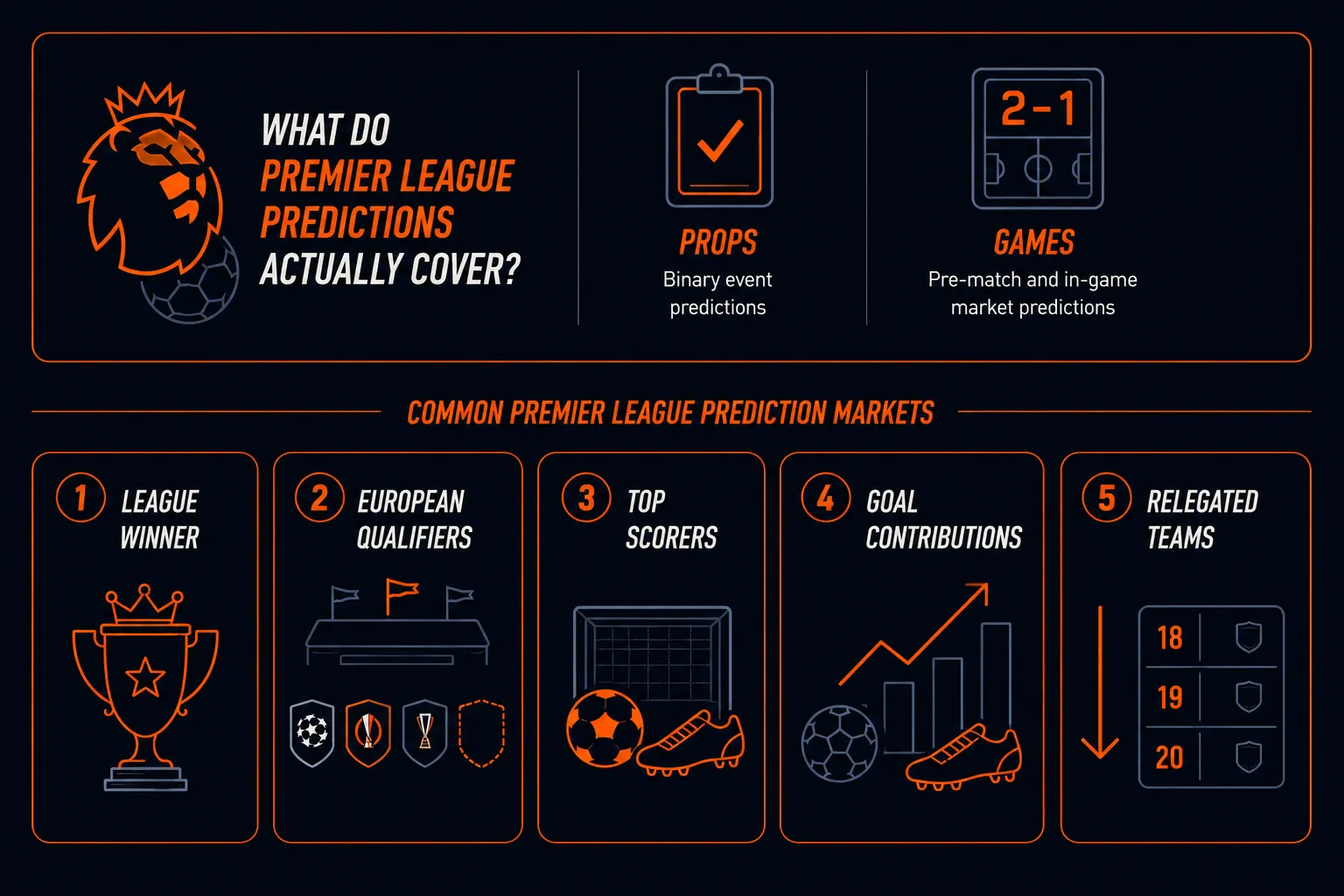
English Premier League predictions markets can broadly be split into two types; props and games.
Prop is short for proposition contract, which is when markets predict the occurrence of a binary event. For example, will a certain player commit a certain number of fouls.
Games refer to markets that take place before and during games. These markets cover a range of predictions, from final score, half time score, goals scored and goalscorers.
Common Premier League prediction markets cover some of the following.
League winner
This is a simple prediction on which team will finish top of the Premier League. For example, in the 2025-2026 season it was Arsenal. A year before that, it was Manchester City.
European qualifiers
This market is nuanced and less straightforward than predicting the winner. It’s a prediction of which teams will qualify for European competitions in the following season.
It typically includes the teams finishing between first place and fifth place, or further down the league standings if teams finishing in the top four also qualify by other means, such as winning the FA Cup, in which case their league qualification slot goes to the team below them.
The top four will qualify for the UEFA Champions League. This may extend to fifth place if a team in the top four wins the FA Cup. This will then extend the qualifying spots down by one league place.
Top scorers
This is a straight call on which players will score the most Premier League goals in a season. Factors that may cause unexpected outcomes include injury or suspension to players expected to score lots of goals and conversely, a breakout season for a moderate goalscorer.
Goal contributions
A combination of goals scored and goals assisted, typically defined as a player having the last deliberate touch before the goalscorer touches the ball. This market is generally harder to call because the player with the most contributions may not immediately stand out.
For example, a newly promoted player who is a highly accurate deadball specialist that’s also the main penalty taker and who chips in with a few goals of their own may outperform more established attacking players in this market.
Midfielders and attacking fullbacks can often surprise pundits with their goal contributions in a single season.
Relegated teams
This market predicts the three teams that will get relegated by finishing 20th, 19th and 18th respectively. In most seasons, this clutch of teams will include at least one of the teams promoted to the Premier League in that season.
Surprises can happen when a previously strong team experiences a major dip in form going into a new season. Injuries to key players, managerial changes and failed transfers can see teams unexpectedly relegated.
How are season-long forecasts built?
There are broadly two approaches to season-long forecasting.
Model-based predictions
The model-based approach is essentially a simulation that gives every club a strength rating. Some models have a rating that moves up or down after each game. And some ratings are split between defence and attack.
As the season progresses, the models tend to become more accurate as more inputs are generated. Most models make adjustments for factors like fixture difficulty, home advantage, form and squad strength.
Prediction markets
Prediction markets operate on a similar theory, but through a different mechanism. The probabilities generated are the result of predictions made; effectively by people putting their money where their mouths are.
In a prediction market, unusual predictions such as a large amount for Hull City to beat Arsenal, can shift the price, but on the whole the markets are calibrated well and absorb new information quickly.
The two approaches are not mutually exclusive. Modellers often refer to prediction markets to check their logic and prediction market participants may look to models for missed information. Neither approach is capable of total accuracy. In Premier League soccer, unexpected results are common. Weaker teams can and do beat stronger teams.
For example, in the 2025-2026 season, Wolverhampton Wanderers won just three games all season. However, two of those wins came back-to-back, against Aston Villa and Liverpool, who finished fourth and fifth respectively. That brief run of form for Wolverhampton would suggest a team capable of finishing in the top half of the table, rather than bottom.
What factors can shift a prediction during a season?
Injuries
Perhaps the most common reason a team will underperform is injury to key players. One injury can derail an entire season.
During the 2020-2021 season, Liverpool defender Virgil Van Dijk ruptured a knee ligament in the Merseyside derby in October and missed the rest of the campaign. With Joe Gomez and Joël Matip also sidelined, Liverpool lost their entire first choice central defence and were reduced to playing midfielders at the back. Despite being reigning champions, Liverpool went through a spell of six straight home league defeats and only secured a top four place on the final day.
European commitments and fixture congestion
Quite often a team will have a great season, finish in the European qualifying spots and struggle the following season due to the greater number of games, extra travel and potential unfamiliarity with playing two tournaments concurrently. Leeds United, Newcastle and Leicester City have all seen European soccer flip their fortunes in the space of a season.
Teams not playing in Europe but who go deep into one or both domestic cup competitions may also experience fixture congestion toward the end of the season, potentially derailing league momentum.
Managerial changes
Managers leaving, either by being fired or taking another job, can throw a team’s season into disarray or it can turn a failing season around. This is more likely to affect teams nearer the bottom of the table who are fighting to retain their place in the league. In the 2024-2025 season, Wolverhampton Wanderers seemed destined for relegation. After sacking Gary O’Neil and replacing him with Vitor Periera, Wolves went on a six-game winning run, the longest of any Premier League team that season and stayed up comfortably.
In the 2025 - 2026 season, Nottingham Forest were riding high after finishing well in the previous season and qualifying for European soccer. After a modest start, they fired manager Nuno Espirito Santo and subsequently spent much of the season fighting relegation.
Momentum
Sometimes things just click and teams will bulldoze their way to success. One win, no matter how lucky, can be all it takes to see a team go on an odds-defying run. The best example might be Leicester City’s title win in 2015 - 2016. From narrowly avoiding relegation the season before, the Foxes bagging a 5,000-to-1 league title remains one of the most remarkable outcomes of any Premier League season.
January transfers
The January transfer window can be an opportunity for buying clubs to rescue a season or turn a good season into a great season. For the teams that lose players, it can be a disaster.
In January 2022, Bruno Guimarães arrived at Newcastle United from Lyon and, alongside Kieran Trippier, Dan Burn and Chris Wood. They collectively dragged a team that was in the relegation places up to safety and finished eleventh.
Two years later, Newcastle United signed Anthony Gordon from Everton, robbing them of their main goal threat and seeing them slump in the standings, retaining the Premier League status by the skin of their teeth on the final day. Gordon, Trippier and Guimarães all left Newcastle this summer, so could they face the same problems?
Can AI or model-based tools reliably predict Premier League outcomes?
AI and models can provide guidance and offer insights into overlooked trends and stats, but it will always be risky to treat them as reliable. They’re extremely useful for wrangling large amounts of data, but the game of soccer is unpredictable by definition. As the famous saying goes, “soccer isn’t played on paper.”
What team will win the league in 2027?
Although it’s hard to predict exactly what will happen at the end of the 2026-2027 Premier League season, it’s worth remembering that the league title is concentrated among a select few teams.
Of the 51 teams to have made it to the Premier League, only seven different clubs have won the Premier League since it began in 1992-93: Manchester United, Arsenal, Chelsea, Manchester City, Blackburn Rovers, Leicester City and Liverpool. This means only 14% of Premier League teams have ever won the league.
In the last 10 seasons (2016-17 to 2025-26) four different clubs have won the title: Chelsea (2017), Manchester City (six times), Liverpool (2020 and 2025) and Arsenal (2026).
Only Manchester City has retained the title in that period and only City, Manchester United and Chelsea have ever retained the title. City did it more than once, including a record four in a row from 2021-22 to 2023-24, plus back-to-back in 2017-18 and 2018-19. No other club has successfully defended the title in the last decade.
The last time a club won the Premier League for the first time was Liverpool in 2019-20 and before them it was Leicester City in 2015 - 2016. Selecting a team from the list of recent winners and accounting for how rare it is for a team to retain the title may steer the markets.
FAQs about Premier League predictions
How many teams have retained the Premier League?
Three. Manchester United, Manchester City and Chelsea. United and City have retained the title more than once. Chelsea have done it once.
Which teams have only won the Premier League once?
Blackburn Rovers and Leicester City, neither of whom are currently in the Premier League. Until the 2024 - 2025 season, Liverpool had only won the Premier League once, but had won the previous incarnation of England’s top league more than anyone apart from Manchester United.
Who has won the most Premier League titles?
Manchester United has the most Premier League titles, with 20. Liverpool has won the top league in all formats 20 times.
Who won the first Premier League title?
Manchester United won the inaugural Premier League title in 1993 and retained it twice in the first five years, bagging four out of five trophies. The last team to win the ‘old First Division’ before it became the Premier League was Leeds United.
What’s the domestic double in English soccer?
The domestic double is when a team wins the Premier League and the FA Cup in the same season.