NFL salary cap: Contracts, cap hits, and dead money explained
Learn how the NFL salary cap works, including cap hits, dead money, signing-bonus proration, void years, and how teams manage cap space each offseason.
Football

NFL contracts ensure that every team can have a competitive chance at constructing a roster. The league institutes a cap so that every organization pays their players the same amount.
How the money is distributed amongst those players is up for the teams to decide. The team gives their player’s contracts that denote how much of the cap space they’ll be receiving and for how many years.
The way the money is distributed is the basis of how rosters are constructed, and it’s up to the General Manager of the team to decide how much each position group gets so that they can build and maintain a competitive roster.
What is the NFL salary cap and why does it exist?
Each season, the NFL decides an amount that each team is allowed to use to pay their players. For 2026, NFL teams are allowed to spend $301.2 million to build a roster. That means each player's salary for the year has to fall underneath the cap number.
How is the salary cap number set each year?
The salary cap is determined each year by how much revenue the league generates. Each year, the league tends to generate more and more money, which is why it seems the salary cap rises every year.
The league determines the exact figure by taking league revenue, subtracting player benefit costs and dividing it equally among all 32 teams.
What is a cap hit in the NFL and how is it calculated?
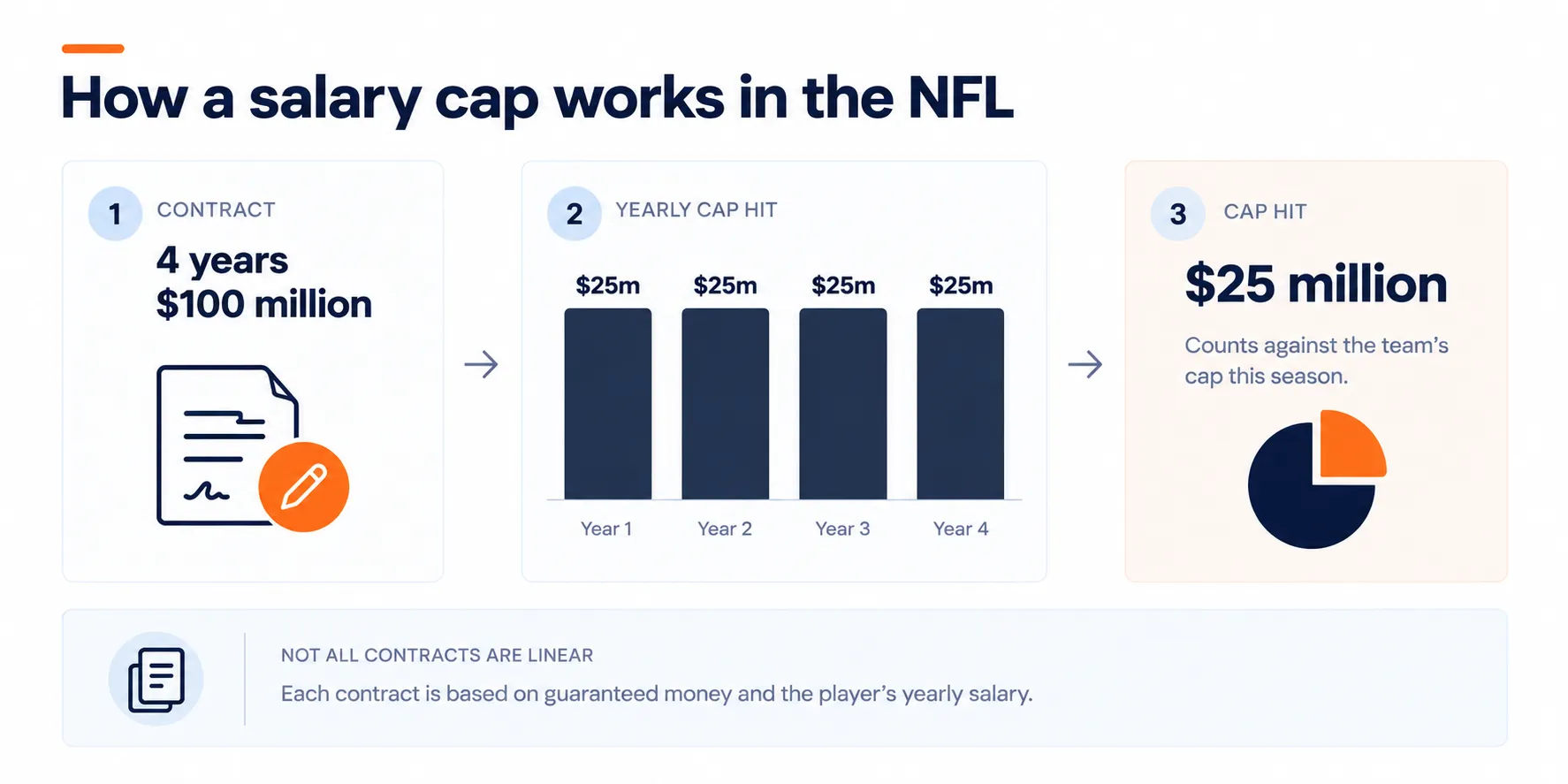
A cap hit is how much a player’s salary takes out of the team’s available cap space. So if your player signed a 4-year $100 million contract, that means the $25 million that they’ll make this season will go against the team’s yearly cap amount.
Each contract is not exactly linear like that example, but it’s based on their guaranteed money and their yearly salary of each season.
How do NFL contracts work?
When a player joins an NFL team, whether by draft or through free agency or trade, they are now under contract with that team. When a rookie comes into the league from the draft, they are promised a minimum amount of $880,000 for being on the roster.
If you are a more coveted player, you will command more money. Jeremyah Love, who was drafted by Arizona this year, just received the highest amount of money for a rookie this year with a 4 year, $53.9 million contract. In order for Love to get paid for his contract, he must remain with the team and participate in the games for the next four years.
Salaries vs. guarantees in a contract
An NFL player's contract is a combination between their yearly salary and their guaranteed money.
A guaranteed contract, either paid throughout the season or as a signing bonus, means that the player will make that amount whether they play in the games or not. That is the lump sum they get no matter what.
For example, the aforementioned Jeremyah Love signed a $35 million signing bonus, compared to his $13.2 million yearly salary.
What is dead money in the NFL?
NFL dead money is explained by the amount of money a team owes players that no longer play on their team. This could mean a variety of things, including they guaranteed part of the player’s salary and then they cut him, or they agreed to pay a part of the player’s salary after they were traded.
Dead money factors into a team’s overall cap space and can hamstring organizations if they have to deal with too much of it. For example, Miami currently has the highest amount of dead money in the league this year. They are paying $183 million to players who are not currently on their roster.
Quarterback Tua Tagovailoa was still guaranteed $55.4 million when Miami released him from their roster, and they still have to pay him that amount even though he is playing in Atlanta this season. They cut Tagovailoa because they decided to move in a different direction at quarterback, knowing the consequences of the dead cap hit they would have to incur.
Dead money causes General Managers to think twice before they offer too many guarantees on a contract.
FAQs about the NFL salary cap
What is the NFL salary cap and what is its purpose?
The salary cap is the amount of money a team is allowed to spend on its players each season. It keeps the competition level consistent for all teams in the NFL.
What is dead money in the NFL?
Dead money is when an NFL team is paying a player who is no longer on their team.
Who holds the record for the largest dead-cap hit in NFL history?
Miami holds the NFL dead cap hit record. They are currently paying $183 million in dead money.
What happens to a player's cap hit when they are traded versus released?
The team that traded away the player is often responsible for their guaranteed money while the player’s new team will take on their salary.
What are void years and how do they affect the salary cap?
Void years in NFL contracts have no guaranteed money left on the player’s contract and they can be cut, released, or traded without incurring dead money on the salary cap.
How much is the NFL salary cap for 2026?
The NFL salary cap for 2026 is $301.2 million.
Can NFL teams roll over unused cap space to the next season?
Yes, unused NFL cap space can rollover to the next season for each team.
How does dead money affect a team's ability to sign free agents?
Dead money shrinks the amount of money you’re allowed to spend on acquiring new players.