You may think that gold will rise, silver will fall or crude oil is heading toward a certain price.
Commodities
By Barbara Pazur
A commodity prediction market makes that view more specific by asking whether the commodity will be above or below a set level at a set time.
This guide explains how commodity price prediction markets work, what can move gold, silver and crude oil prices and what to check before trading.
This article is for informational purposes only and should not be construed as financial or investment advice. Past performance does not guarantee future results.
What are commodity prediction markets?
Commodity prediction markets are event contract markets based on measurable outcomes linked to commodity prices. We’ll focus on three markets here: gold, silver and crude oil.
A contract may ask whether a gold, silver or crude oil reference value will be above a specific threshold at a specified observation time. That makes the contract different from a general commodity price prediction about whether the market may rise or fall.
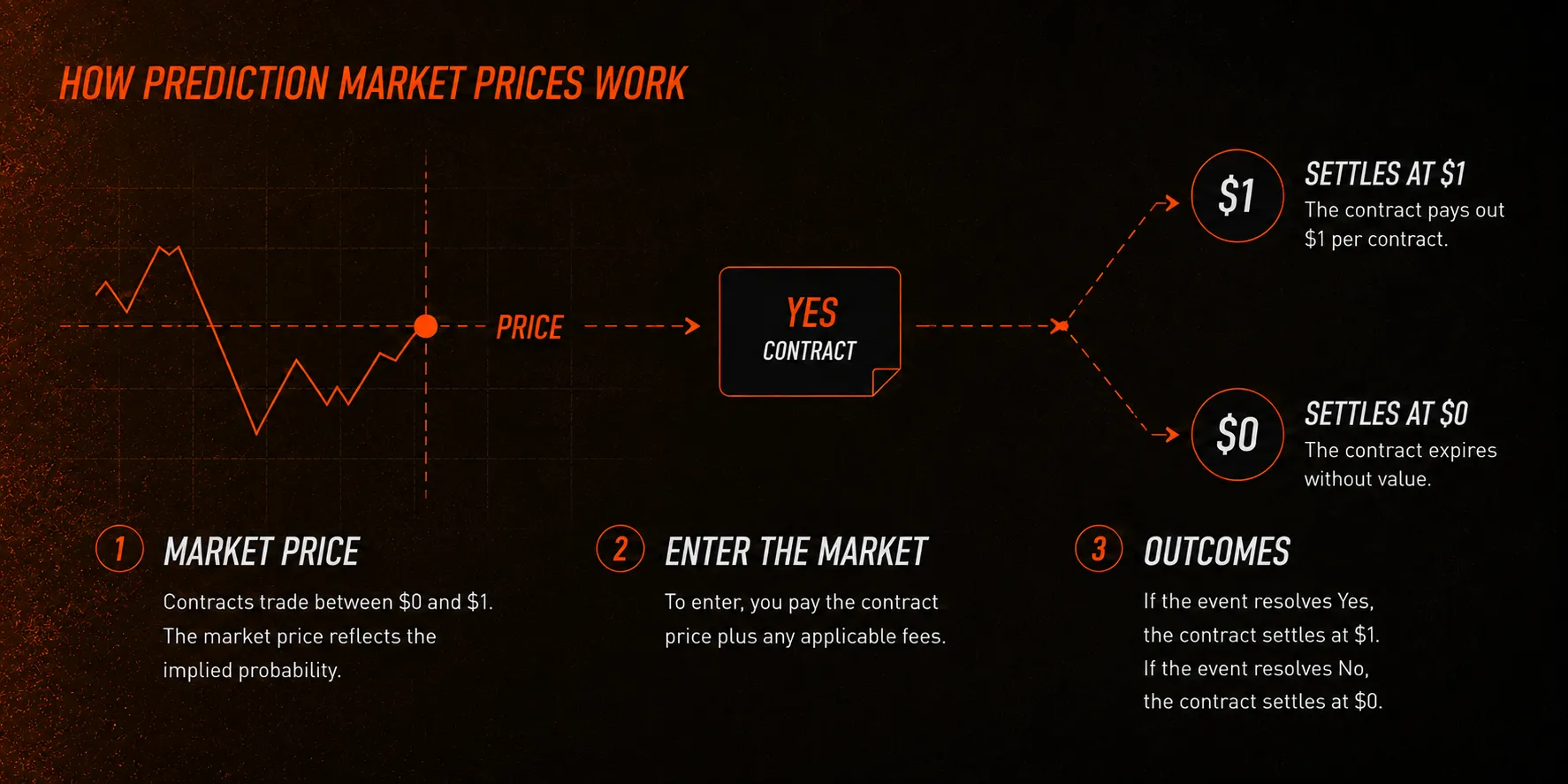
A 59¢ gold contract points to about a 59% market-implied chance that the price condition will be met. That percentage belongs to the contract outcome, and it doesn’t mean traders expect gold itself to rise by 59%. It reflects how the market is pricing that exact price threshold under the contract rules.
How do commodity prediction markets work?
Let’s use a gold price prediction contract as an example. The contract asks if the gold index value will be above a stated price at 1:30 p.m. ET.
Here’s what the contract is measuring:
Reference market: Gold index value.
Price threshold: The stated price.
Observation time: 1:30 p.m. ET.
The event-contract price can move as the gold reference value moves. It can also change when traders reassess how likely gold is to reach or stay above the threshold by the observation time.
Which commodities can you trade in prediction markets?
Commodity prediction markets work best when the price reference and settlement rule are clear. OG.com commodity markets currently focus on daily price-based contracts for:
Gold contracts can let traders take a view on whether a defined gold reference value will finish above a specified threshold.
Crude oil contracts can use the same price-threshold structure, while the underlying oil market responds to a different information set from precious metals.
Silver offers another precious-metals market, but its price drivers can differ from gold, so a silver price prediction shouldn’t be treated as a smaller version of a gold trade.
Available contracts and thresholds can change, but the framework stays the same. Read the commodity, price condition, observation time and settlement rule before judging the price.
Daily commodity markets put the observation time at the center of the contract. Touching a level during the day and being above that level at the observation time can lead to different outcomes.
Let’s stay with the gold example we used. Say a gold contract asks whether its reference value will be above a stated price at 1:30 p.m. ET. Gold could move above that level at 10:00 a.m., fall back later and remain below it at the official observation point.
If the contract uses the 1:30 p.m. value, the earlier move doesn’t decide settlement. The final result depends on the value named in the rules. If the event occurs, the Yes contract settles at $1. If it doesn't, it settles at $0.
What affects gold, silver and crude oil prediction market prices?
A commodity contract starts with the reference price. If gold, silver or crude oil moves closer to the threshold, the contract price can move too. What drives that move depends on the commodity.
What affects gold prediction markets?
Gold often reacts to shifts in the U.S. dollar, interest-rate expectations, inflation concerns, geopolitical stress and demand from investors or central banks.
For a daily gold contract, those drivers only matter because they can change the chance that gold finishes above or below the contract’s price level at the observation time.
What affects silver prediction markets?
Silver can move with gold when traders are focused on precious metals, the U.S. dollar, rates or inflation expectations. But silver also has an industrial side, so growth expectations and demand from manufacturers can affect the price too.
That’s why a silver price prediction shouldn’t be treated as a smaller version of a gold price prediction. The two markets can overlap without moving in lockstep.
What affects crude oil prediction markets?
Crude oil responds more directly to supply and demand. Production decisions, inventory reports, geopolitical disruptions, economic-growth expectations and changes in expected consumption can all move the underlying oil price prediction.
Oil prediction markets can reprice quickly when the supply-demand picture changes. For a daily crude oil contract, the key question is whether that move is enough to clear the contract’s threshold by the observation time.
How do commodity price targets work in prediction markets?
A commodity price target is the level the reference value has to meet under the contract rules. The market price can shift based on where the commodity is trading, how far it’s from the threshold and how much time is left before the observation point.
If gold is trading near $4,450, a contract asking whether it’ll be above $4,460 at the observation time will usually be priced differently from one asking whether it’ll be above $4,500. The second contract requires a larger move before time runs out.
If volatility picks up, the distance from the target can shrink faster than traders expected. A farther threshold can still reprice before settlement, especially when gold, silver or crude oil moves sharply.
Why do traders use commodity prediction markets?
Commodity prediction markets turn an idea about gold, silver or crude oil into a specific price question. The contract says which commodity is being measured, what price level it needs to meet and when that measurement happens.
The market price gives traders a read on how the market is pricing that outcome before the observation time. As gold, silver or crude oil moves, or as new information changes expectations, the market-implied probability can change too.
That gives traders a different way to frame a commodity view. They’re trading a defined outcome rather than open-ended exposure to the full price move of the commodity, but the contract still carries risk and can resolve against them.
Commodity prediction markets vs commodity futures
Feature
Commodity prediction market
Commodity futures
Key difference
Exposure
Defined event outcome
Commodity futures price
Different payoff structure
Time
Defined observation or settlement point
Futures contract expiry
Time works differently
Outcome
Settles according to event rules
Value changes with futures price
Different settlement mechanics
Main question
Will the specified outcome occur?
How will the commodity price move?
Different trading thesis
Two traders can have the same view on gold or crude oil and still get different results because the instruments answer different questions. A futures position follows the futures price. A commodity prediction market resolves on whether the contract’s defined outcome occurs.
Gold could finish the day higher overall and still remain below the threshold required for a particular prediction contract to settle Yes.
What are the risks of commodity prediction markets?
A commodity price move can miss the contract’s threshold or observation time, and a losing outcome may cost you the amount paid to enter, plus fees.
Gold, silver and crude oil prices can move quickly when new economic, geopolitical, supply or demand information arrives. Liquidity can vary by market, and volatility or sudden price moves can affect the price at which a trader can enter or exit.
A trader may expect crude oil to move higher, but the contract still needs the reference value to meet the exact level in the rules.
Gold, silver or crude oil may also cross the target earlier in the session, then move back before the official observation time. That means a contract with a high market-implied probability can still settle the other way.
What should you check before trading a commodity event contract?
A commodity contract can look simple in the market title, but the rules tell you what price actually counts. Before trading, check the details that decide settlement:
Reference market: Is the contract based on gold, silver, crude oil or a specific reference index?
Price condition: Does the contract ask for the value to finish above or below the threshold?
Observation time: When is the price measured, and which timezone applies?
Reference-price source: Which source supplies the value used for settlement?
Settlement rules: How does the contract handle fees, unusual market conditions, data issues or other contract-specific terms?
The wording around time is especially easy to misread. “Will gold trade above $X at any point today?” and “Will the gold reference value be above $X at 1:30 p.m. ET?” aren’t the same contract.
In the first case, touching the level during the session could be enough. In the second, the earlier move doesn’t decide the result if gold falls back before the 1:30 p.m. observation time.
How to trade commodities prediction markets on OG.com
With OG.com, you can trade event contracts on real-world outcomes across gold, silver, and other commodities.
Create an account: Open an account and complete sign-up, including identity verification. You can use our web or mobile platforms.
A commodity prediction market is an event market tied to a measurable commodity-price outcome, such as whether gold, silver or crude oil will be above a set level at a set time.
How do commodity price prediction markets work?
Commodity price prediction markets use contracts with a reference commodity, price threshold, observation time and settlement rule. The contract resolves based on whether the stated condition is met.
What affects gold price predictions?
Gold price predictions can be affected by the U.S. dollar, interest-rate expectations, inflation expectations, economic uncertainty, geopolitical developments, investment demand and central-bank activity.
What affects silver price predictions?
Silver price predictions can be affected by precious-metals demand, the U.S. dollar, interest-rate expectations, inflation expectations, industrial demand and broader economic activity.
What affects crude oil price predictions?
Crude oil price predictions can be affected by supply and demand, production developments, inventory information, geopolitical disruptions, economic growth expectations and expected oil consumption.
How do commodity price targets work in prediction markets?
A price target is the level the commodity reference value needs to meet under the rules. The contract may ask whether the value will finish above or below that level at the observation time.
What is the difference between commodity prediction markets and commodity futures?
Commodity futures track the value of a futures contract. Commodity prediction markets settle on whether a defined price outcome occurs under the event contract rules.
Important information: Prediction is an event contract that is a derivatives product offered by North American Derivatives Exchange, Inc. (NADEX), a CFTC-regulated exchange, which does business under the brand OG.com Prediction Markets (OG). Crypto.com | Derivatives North America uses a CFTC-regulated exchange that uses OG.com technology.
Trading on OG.com involves risk and may not be appropriate for all. By trading you risk losing your cost to enter any transaction, including fees. You should carefully consider whether trading on OG.com is appropriate for you in light of your investment experience and financial resources. Any trading decisions you make are solely your responsibility and at your own risk.