Hydration breaks: what they mean for soccer prediction markets
The 2026 Soccer Championships have introduced mandatory hydration for players for the first time. However, these breaks have already been cancelled for the 2028 championship.
Soccer
By Sean O'Meara
This article explores the spectrum of views, the impacts on the pitch and the prediction market opportunities hydration breaks bring.
This article is for informational purposes only and should not be construed as financial or investment advice. Past performance does not guarantee future results.
What are hydration breaks in soccer?
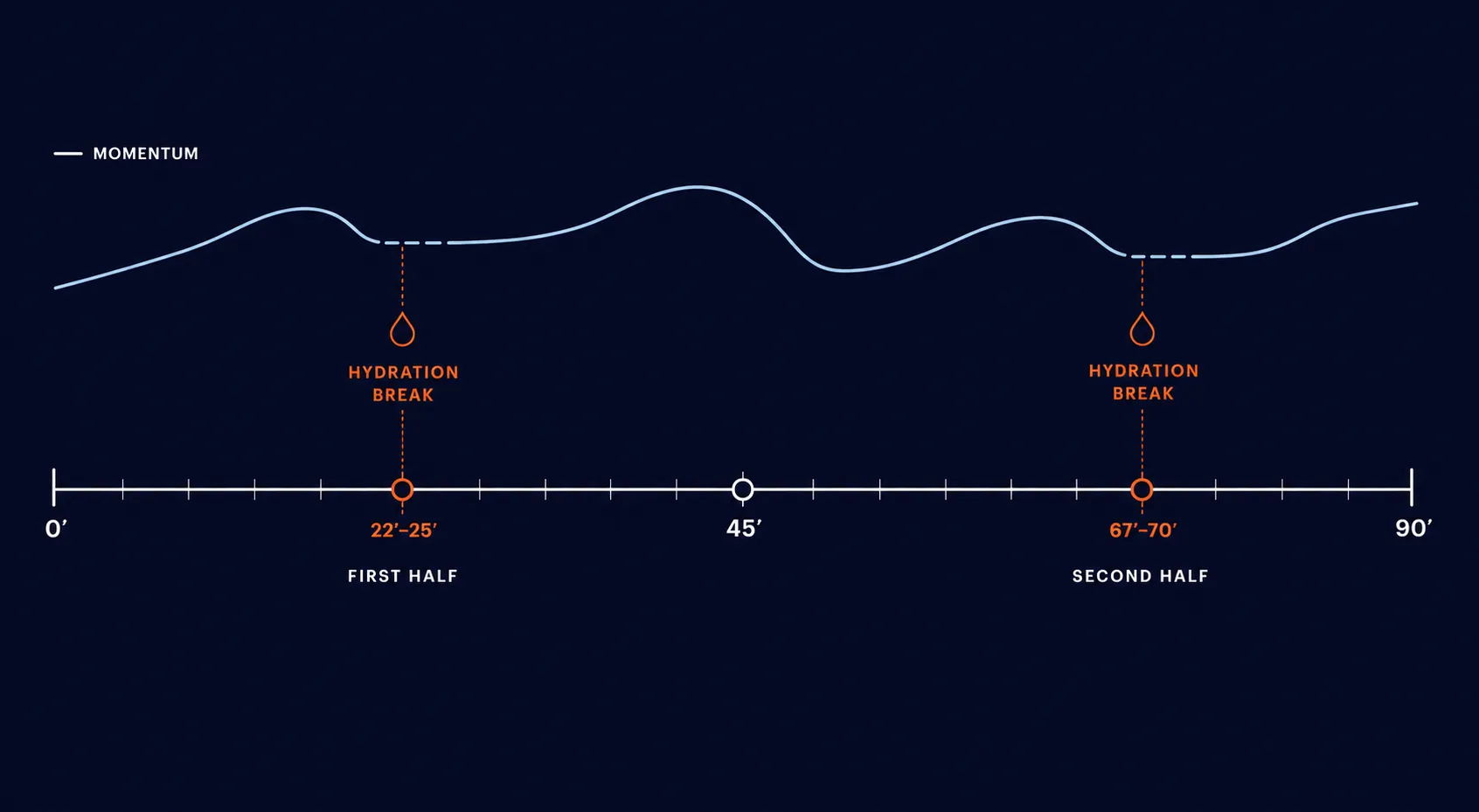
Players often grab a drink during a pause in play, for example if a player is receiving treatment for an injury. Hydration breaks are different. They are mandated breaks roughly timed for the midpoint of each half. Players are required to approach their team bench.
It’s an opportunity for players to rehydrate and also a chance for coaching teams to speak to players. For this reason, critics argue that they disrupt the natural flow of the game and penalise teams that may have been enjoying a period of dominance.
Some even go as far as saying they’re an opportunity for broadcasters to show more adverts, effectively splitting the game into quarters. Organizers have stated that they’ve generated no extra advertising revenue from having hydration breaks.
How long are hydration breaks?
Hydration breaks are officially mandated at three minutes, but the game clock keeps rolling during the break.
This factor has also caused controversy, as referees are required to add the time taken for the hydration break to the end of each half, meaning players and spectators are unsure of exactly when each half is due to end.
Why does the 2026 Soccer Championship have hydration breaks?
The use of hydration breaks was formally announced in December 2025, long before the start of the soccer championships. Tournament organisers said that the breaks were to protect players from dehydration.
While some were against the breaks, claiming that they were for the benefit of advertisers, tournament sources have argued that broadcast deals were structured and agreed before the breaks were mandated.
Others have observed that non-contact injuries, such as cramp and strains, which often cause delays toward the end of games as players fatigue, have been less of an issue. Many attribute this anecdotal observation to players being better hydrated throughout the game.
When did hydration breaks start in soccer?
In the last 2022 Soccer Championships in Qatar, hydration breaks were optional depending on the temperature at the time of the game. Hydration breaks at this tournament are controversial, with some arguing they impact the flow of the game.
Others see the breaks as a player welfare issue, arguing that summer temperatures demand an intervention. The concept originated in the previous Soccer Championships, held in Qatar. Because of Qatar’s hot and dry climate, hydration breaks were an option when temperatures exceeded 89.6 degrees.
Are hydration breaks used because of high temperatures?
Not always. Because the games are being played across Mexico, USA and Canada, temperatures vary quite significantly. But organisers have demanded that every game feature two hydration breaks.
With stadiums in Dallas, Houston and Atlanta having air conditioning, pitchside temperatures have been relatively cool. The hottest recorded temperatures as of June 18th were in New York City, Seattle and Philadelphia, with each game exceeding 84 degrees.
The game between Austria and Jordan in San Francisco had the lowest recorded temperature, with the mercury hitting a cool 61 degrees at kick off.
Why hydration breaks are controversial
Critics argue that they’re unnecessary and disrupt the flow of the games. Other critics say the breaks fundamentally alter the structure of the game, making it a game of four quarters rather than two halves.
How hydration breaks can affect soccer prediction markets
Because hydration breaks are a new concept, it’s been an interesting variable affecting prediction markets. The challenge for traders is understanding whether any variations in outcome or big game moments are correlation or causation.
Now the group stages have finished, we’ve had 36 games where the break has been mandatory. This does not make for a statistically significant sample for hard conclusions. But there are some interesting things to note.
Here are all the goals scored five minutes after a hydration break in group stages.
Game
Goal (result)
Mins after break
Half
Impact on match
Norway 4-1 Iraq
(1-0)
shortly after (first shot post-restart)
1st
Opened scoring.
Norway 4-1 Iraq
(3-0)
~3 min
2nd
Extended lead to 3-0
Scotland 1-0 Haiti
(1-0)
~3 min
1st
Winning goal and only goal of the game.
Australia 2-0 Turkiye
(1-0)
first shot after restart
1st
Opened scoring.
Australia 2-0 Turkiye
(2-0)
~5 min
2nd
Extended lead to 2-0.
Japan 4-0 Tunisia
(2-0)
~4 min
1st
Extended lead to 2-0.
Canada 1-1 Bosnia
(1-1)
"just after"
1st
Equaliser for Canada that earned Canada's first WC point.
The trend is continuing into the round of 32.
In their first and only game in the knockout stages, Japan scored approximately seven minutes after the first hydration break. Before the break, Brazil were dominating possession and pinning Japan into their own half. After the break, Japan were able to wrestle momentum away from the South Americans and open the scoring.
What traders should watch after a hydration break
Watch tempo: Did the match slow down or speed up after the pause?
Matches naturally slow after a restart as teams have a chance to regroup and get into formation. However, there have been clear examples of hydration breaks affecting the flow of a game. Of the goals scored within five minutes of a hydration break in the first 36 group stage matches, the majority saw a winning team extend their lead.
It’s also smart to look at what might happen before a hydration break. Impending stops in play can affect mentality and strategy. Teams that are winning may become more defensive, teams chasing a game may elect to throw more men forward knowing there’s a pause coming.
Watch pressure: did one team come out with a clearer plan?
Hydration breaks are an opportunity for a team to regroup and for coaches to pass on instructions. Before hydration breaks, coaches would have to wait until half time to do this, or at best rely on communicating with players while the game is in flow.
Hydration breaks are making games more tactically dynamic as coaches no longer need to wait until the midpoint of the game to instruct their players.
Watch fatigue: are players recovering better or still struggling with heat?
The stated goal of hydration breaks is to help players cope with heat and avoid dehydration. There’s insufficient data to determine whether players are recovering better and avoiding injury compared to games without hydration breaks, but it’s hard to argue that a short break and a drink wouldn’t have a material impact on a player’s performance. Observers have noted that there seem to be fewer non-contact injuries late on in games, such as cramps, but these observations are currently anecdotal.
One thing traders may want to watch is the performance of older players, who experience an outsized benefit from a hydration break compared to younger players. Are older players lasting longer in games compared to previous competitions?
Watch the market: compare price movement with the match state, not just the score
Keep an eye on how the markets are reacting to the match state. Prediction markets let traders buy contracts tied to future event outcomes. Market prices can be read as a rough signal of how likely traders think an outcome is. For example, a contract trading at 60¢ can generally be read as a 60% market-implied chance, before fees and market rules are considered. If this figure moves significantly after a hydration break it could imply that the market is seeing a shift in game state. Before trading, review the rules, fees, risks, and settlement details for the specific market and platform.
How to trade soccer prediction markets on OG.com
With OG.com, you can trade event contracts on real-world outcomes across different market categories.
Create an account: Open an account and complete sign-up, including identity verification. You can use our web or mobile platforms.
Browse soccer markets: Explore event contracts for the upcoming soccer matches.
Review and trade: Compare the market price with your own view. Check the rules, fees, and settlement details before opening a position.
Monitor your position: After trading, your contract appears in your open positions, where you can track price movement as new information comes in.
Hydration breaks are mandatory stoppages where players leave the field for drinks.
How long are hydration breaks in the 2026 Soccer Championship?
Hydration breaks are mandated to last three minutes, although the official game clock doesn’t stop. The referee adds the time onto the end of each half.
Why are hydration breaks being used in the 2026 Soccer Championship?
Optional, temperature related hydration were trialled at the previous Soccer Championship in 2022. The tournament organizers announced in December 2025 that every game would include two hydration breaks to make sure players had adequate chances to stay hydrated.
Do hydration breaks happen in every match?
Yes. Two hydration breaks per match, one in each half, are mandatory for the 2026 Soccer Championships.
Can hydration breaks affect match momentum?
Yes. In a few games already at the 2026 Soccer Championships, the momentum of a game has switched after a hydration break. In some cases, teams have scored against the previous run of play.
Can hydration breaks affect prediction markets?
Yes. Since they’re an opportunity for coaches to reset their team, for players to discuss tactics and a natural pause in play, the likelihood of certain outcomes can change because of a hydration break.
Important Information: Prediction is an event contract that is a derivatives product offered by North American Derivatives Exchange, Inc. (NADEX), a CFTC-regulated exchange, which does business under the brand OG.com Prediction Markets (OG) Crypto.com | Derivatives North America and uses a CFTC-regulated exchange that uses OG.com technology.
Trading on OG.com involves risk and may not be appropriate for all. By trading you risk losing your cost to enter any transaction, including fees. You should carefully consider whether trading on OG.com is appropriate for you in light of your investment experience and financial resources. Any trading decisions you make are solely your responsibility and at your own risk.