How much prize money does the Premier League winner get?
Did you know that teams relegated from the Premier League can earn more from prize money than the winners of other leagues? Even one season in the EPL can be worth mega millions. We’re digging into how Premier League prize money works, how much the winners get, who else gets what and how new deals stand to make Premier League clubs even richer.
Soccer
By Sean O'Meara
Have you ever wondered what it’s worth to win the Premier League? In this article we’re exploring how much the winner receives, how it’s calculated and looking at the one big reason Premier League prize money is unique.
The Premier League is based on ‘merit payments’, rather than prize money. There is no winner’s prize. And in fact, even the team finishing bottom of the league receives a merit payment, often much higher than winners in other leagues.
Teams also receive an equal share of other revenue pools, such as television rights. These come from a ‘central revenue system’. So in total they receive a combination of television rights payments, merit payments and other commercial income, which can be affected by league position.
The merit payments are, as the name suggests, based on performance. And the first-placed team receives the largest one. So in that sense, the winners get something like a winner’s prize, but that’s not how it’s calculated.
It’s more of a sliding scale, with positions determining the multiple of the basic merit payment. So the easiest way to think of it is like this. The team finishing top receives a 20x multiple of the basic merit payment. The team finishing second receives a 19x multiple and so on. The Premier League winner gets a minimum of £50m Premier League prize money.
Three revenue streams that determine every club's payout
Every team in the Premier League earns money in three ways:
Equal share income from the central revenue system
Merit payments for league position at the end of the season
Facility fees, also known as appearance fees, which are based on how many times a team is shown on live UK television.
Aside from these revenue streams, teams earn revenue from commercial deals and qualification into other tournaments associated with their league finish.
For example, Arsenal qualified for the Champions League due to winning the Premier League, so they’ll earn revenue from that, too.
A team’s revenue can increase or decrease indirectly due to its league position at the end of the season. Many commercial deals, such as kit sponsorship and official partnerships have fees contingent on performance. So a sponsor may end up paying a team more if that team finishes higher up the league table.
How merit payments work: 1st to 20th sliding scale
The payments work on a sliding scale, with equal differences between each place. We could think of the merit payments as shares from an overall pot, with each share worth roughly £2.65 million (~$3.55 million) in 2024-25.
So the entire merit payment pool is worth about £557 million (~$746.4 million) shared across all 20 clubs. The champion's 20 shares represent just under 10 percent of the total and the team finishing 20th gets 0.5%.
Premier League prize money by position
Position
Merit payment
1st
£53.1m ($71.2m)
2nd
£50.4m ($67.5m)
3rd
£47.8m ($64.1m)
4th
£45.1m ($60.4m)
5th
£42.5m ($57.0m)
6th
£39.8m ($53.3m)
7th
£37.2m ($49.8m)
8th
£34.5m ($46.2m)
9th
£31.9m ($42.7m)
10th
£29.2m ($39.1m)
11th
£26.5m ($35.5m)
12th
£23.9m ($32.0m)
13th
£21.2m ($28.4m)
14th
£18.6m ($24.9m)
15th
£15.9m ($21.3m)
16th
£13.3m ($17.8m)
17th
£10.6m ($14.2m)
18th
£8.0m ($10.7m)
19th
£5.3m ($7.1m)
20th
£2.6m ($3.5m)
Example: Liverpool 2024–25 broken down
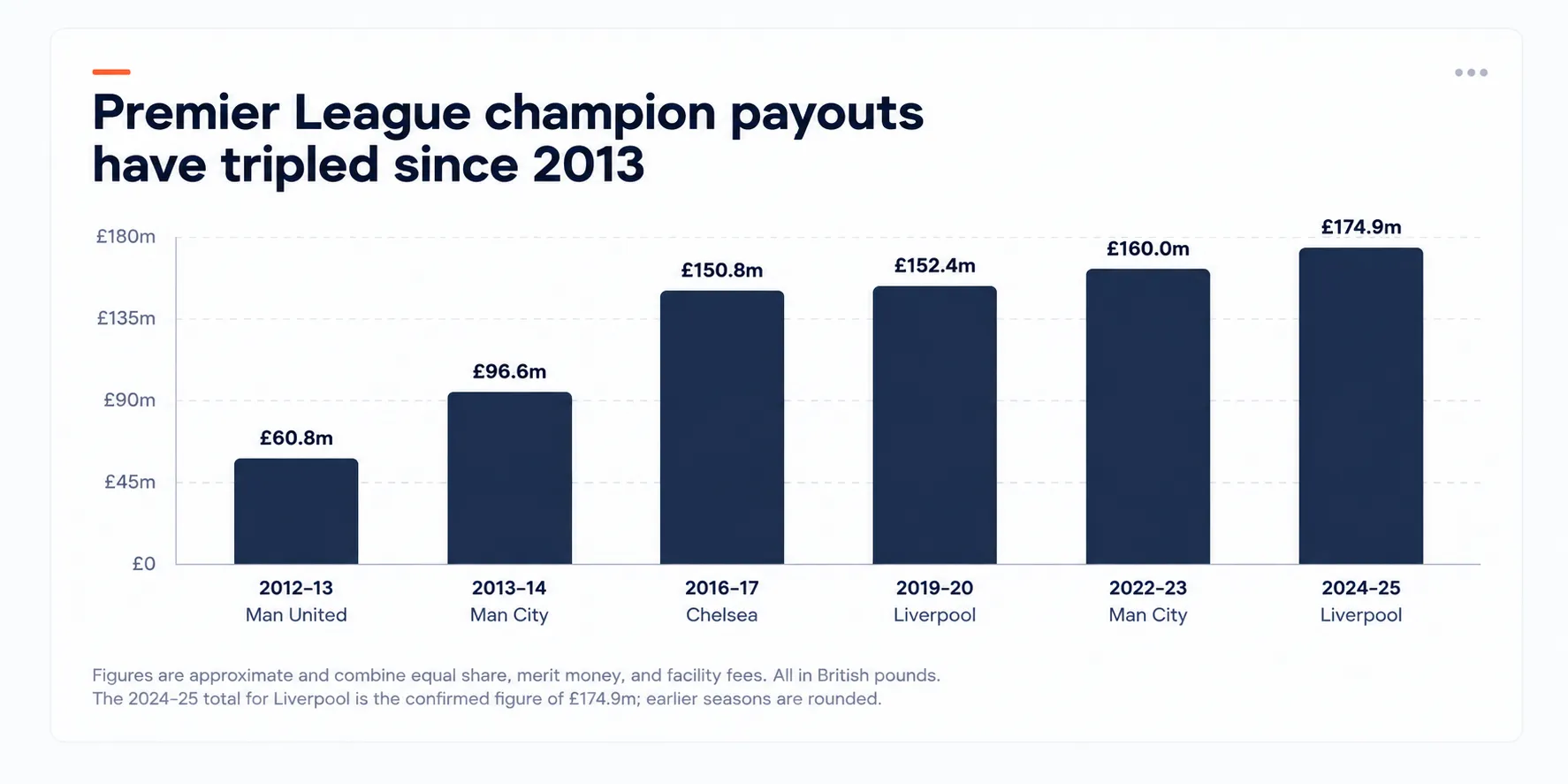
When Liverpool won the Premier League in 2024-2025, they earned a total of around £174.9m ($234.4m).
£96.9 million ($129.8 million) of that was from their equal share of the central revenue distribution.
£53.1 million ($71.2 million) was merit payments.
£24.9 million ($33.4 million) was facility payments.
Premier League prize money in US dollars
Using an exchange rate of about 1.34 dollars to the pound, as of September 2026, prize money of £174.9 million comes to roughly $234 million.
The first-place merit payment of £53.1 million equals approximately $71 million. The 20th place merit payment of £2.6 million equals around $3.5 million. These figures go to show why Premier League status is so lucrative for English soccer teams.
How champion payouts have grown
Payments for winning The Premier League have grown a lot over the past decade. This is due to increased revenue from global audiences streaming into the league, plus more negotiating power from the member clubs.
How the Premier League compares to other leagues/competitions
The team that finishes last in the Premier League often nets more revenue than teams who are champions of less lucrative leagues.
Larger leagues like Serie A in Italy and La Liga in Spain, where revenues are high, split the money less evenly. So while the top teams may earn revenue compared to the top teams in England, the lower ranked teams earn significantly less.
What else does winning the PL get you?
Beyond the trophy and medals, the champions claim an automatic place in the following season's Champions League, which is worth far more than the roughly £2.7 million (~$3.6 million) gap between first and second in merit money. It also drives commercial value: bigger sponsorships, higher shirt sales, and stronger appeal to top players and future broadcasters.
Winning the Premier League has a lot of benefits aside from the cash distribution. Champions league qualification is lucrative in and of itself.
The total prize pot is roughly £3.8bn (~$5.1bn). Every team that qualifies receives a minimum of £16.1m (~$21.6m), with an additional £1.8m (~$2.4m) for every game won and £600,000 (~$804,000) for every game drawn.
Aside from qualification to other competitions, Premier League champions tend to sell more merchandise, sell more matchday tickets, can charge more for player sales, pay less for player purchases and demand more for sponsorship and partnership deals.
What new broadcast deals could mean
The domestic broadcasting deal in place for the 2025-2026 season is the most lucrative in Premier league history and is worth around £6.7 billion (~$9.0 billion) over four years. The international market is growing too, which may eventually see the equal share payments and merit payments increase accordingly.
FAQs about Premier League prize money
Why is the Championship Play-off final the ‘richest game in the world’?
The winner earns promotion to the Premier League and at least £109 million from broadcast and league payments. With so much money riding on one match, it is often called the richest game in world soccer.
What are Premier League parachute payments?
Premier League teams often spend more on players, wages, staff and facilities. If they are relegated, their income falls sharply while many costs remain. Parachute payments help cover this gap, including contracts signed on Premier League wages.
What happens to a team’s revenue if they get relegated from the Premier League?
It’s a significant drop in both guaranteed payments, TV revenue and often ticket sales. Sponsorship payments may drop too, especially if the deals are contingent on Premier League status. Teams may offset these losses by selling valuable and highly-paid players.
Who decides how much prize money Premier League teams receive?
The Premier League, which functions as a membership organization with shareholders, sets the Premier League prize money allocations.